By: Kelvin Tjiringa
Like meeting a black man wielding a primed grenade in a “Whites Only” lavatory.
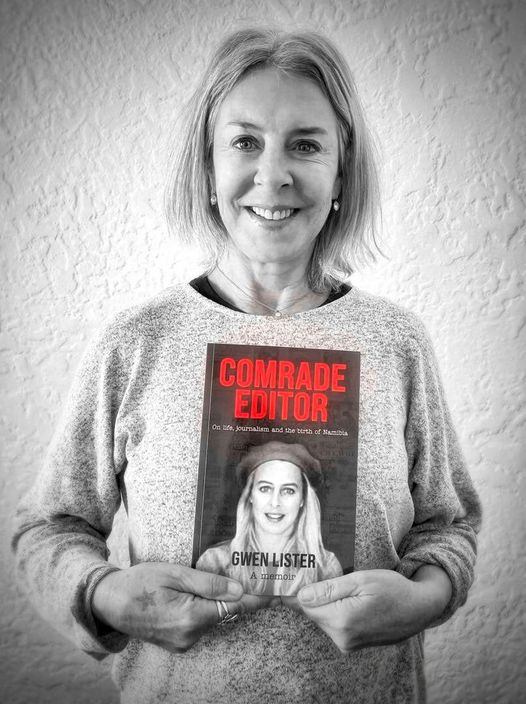
This is the very immediate impression Gwen Lister’s memoir, Comrade Editor, creates to the curious reader who finds fascination with the history behind the history of the victors.
The book’s title is saturated with strong third world socialist revolutionary undertones and starkly captures the blurred lines between the sacrosanct ethos of impartial reportage and intrepid left-leaning journalistic activism that takes a stance against forces on the wrong side of history.
In this body of work, Gwen Lister, a veteran struggle journalist of repute whose name needs no introduction, has profoundly captured the difficult history of the birthing of a nation, the intricate contradictions of apartheid, the flirtatious uncertainties of the destiny of the freedom fighter, and at the center of it, the role of a besieged journalist.
Lister ushers us into her psychedelic world of juvenile delinquency characterized by the impulsive infatuations of a child born into a rigid chauvinistic world, the experimental flirting with drugs, sexual awakening and intellectual rebellion.
From the settings of apartheid South Africa where her family finds itself due to the practical immediate demands of work, she is born into privilege but is able to question the morality of the same at a very prime age.
She is rootless in the very genesis of her being, taken from here to there, to wherever the banking institution needed her father.
She is born into a world at cross-roads, a century in the torrid Odyssey of Harold Macmillan’s proverbial winds of change and a black world awakening to the true realities and magnitude of its oppression.
She is by default curious.
Her curiosity is driven by the organic contradictions of the segregated society she lives in, a family that is sympathetic to the plight of the impoverished black man but unquestionably loyal to the archdemons of oppression at the heights of her South Africa’s econo-socio-political edifice.
She tells the story of a difficult upbringing, where her father, whom she equally adored, misled by example as he dabbled into his dark world of alcoholism but whose misogynistic views perpetuated the restrictive oppression of women.
But Lister is a rebel.
She is destined to climb the daunting heights of history as a conveyor belt for a raging revolution that was sweeping the tide of history towards Namibia’s inevitable independence even if that meant drawing the lines in the sands between her kind, and the black “scum of the earth”.
In the matrix of individual conviction and the demands of apartheid, Lister rebels against her own skin and all that it represented.
It seems she is in a constant struggle to flee from her own whiteness.
At a very early age, her curious ever questioning mind psycho-analyses a country that was not in the true sense of the word, a country, but a huge white suburb managed by a very nationalist, right-wing white supremacist establishment.
She takes the reader through the terrible contradictions of white privilege, one which was propped by a rigid Boer dictatorship ready to hurl the Molotov cocktail in the direction of even its own kind if they questioned the moral compass of its empowerment through black disenfranchising project.
From the pristine intellectual precincts of the University of Cape Town, Lister is caught up in her own struggle, that of resistance against oppression, but one which resonated within the black locations and one which would prepare her and be the prelude to the struggle that lay ahead.
Born in South Africa, destiny dictates that Lister should cut her journalist teeth within the tempest of the making of the history of Namibia, from its old skin of colonial South West Africa.
She has to break the heart of her first-time true lover, Tommy, and give up on everything she grew up around, to face the lurking antagonistic creatures of retrogressive race politics in Namibia.
Yet in re-telling this story with remarkable pin-point accuracy, Lister juxtaposes the perils inside her own micro-cosmic world because as much as she is a mother and a wife, she still has to meet deadlines at a controversial newspaper that is hurling brickbats at the establishment.
The practical threats and problems of the macro-cosmic world within which her career catapults her means the micro-cosmic must suffer, and along with the tide of the demands of covering a country in the grips of war, she loses her marriage.
She is marked by disaster from the very first time she checks into the Windhoek Advertiser where she will have to work alongside an eccentric old school journalist and editor who does not believe the journalistic craft is for women.
She has to deal with sexual harassment and the lascivious pre-disposition of a slave-driving manager who revels in an uncouth world of drink, sex and promiscuity yet remaining true to the profession of journalism ______________ Hannes “Smittie” Smith.
Her old school newsroom was the amphitheater of journalistic shock combat where the political beat was the deep-end seldom handled by women, and racy, raunchy tabloidism excited a peculiar kind of audience.
It was the scene of manual multi-tasking which at the end of it sought to create a complete organic practical journalist who was in sync with the community and created intricate relationships with the makers and drivers of news.
….?? 1980 ? ???? ????ℎ ?? ?? ????? ?ℎ???, ?ℎ???. ? ℎ?? ℎ????? ?????ℎ?? ?????????? ????????, ?? ? ????? ???? ?? ????? ?ℎ? ????ℎ ?? ?? ????ℎ??? ???? ???ℎ? ????? ?????, ?????? ??? ?? ????? ???????, ?ℎ?? ? ?ℎ?????ℎ-??????? ??????? ??????? ?? ?ℎ? ℎ??????? ???ℎ ? ???? ?????? ?????ℎ?? ?? ℎ?? ?ℎ???. “???????????????,” ℎ? ????, ???????? ?? ?? ??? ????. “??? ??? ??? ???? ?? ????? ???? ???????” ….
It was also a battlefield of inter-media-house antagonism where editors faced off and would get pissed by each other while cartoonists won the day and swayed public opinion with intelligently crafted caricatures and satires of the everyday troubles of a normal apartheid society.
By its very nature, the newspaper was subject to the sinister control of corporate politicians where ownership could be used as a lethal weapon to allow for on the one end, journalistic spin doctoring, and on the other, to make or break one’s career.
Lister would be spooked out of the ?????????? and compelled to co-found the ????ℎ??? ???????? due to the change in ownership with the paper firmly in the hands of Dr. Dieter Lauenstein.
The ????ℎ??? ???????? would too suffer corporate political infiltration where business sustainability necessitated a change of hands, throwing her into the cold before founding The Namibian.
Indeed, Lister’s rise to the pinnacles of her craft, where she has to double excel and double impress to be accepted means she had to morph herself, within the space of her memoir, into a feminist megaphone super-imposing to the 21st Century generation, the struggles women had to put up with to be accepted in a mainstream macho society.
She is the victim of sexual advances, victim to the threats of an unshackled sexual urge even from the most respectable members of the propertied upper social class.
At the same time, her role in telling the story of the Namibian revolutionary means she has to be a communist caricature in an unforgiving conservative white society of her time.
… ?? ??????? ?ℎ? ?????? ?ℎ??? ???? ?? ?ℎ??? ??? ℎ??????? ?? ????????? ???ℎ ?ℎ? ??????????? ?? ?ℎ? ????? ????????, ? ??? ?????? ???? ?ℎ???? ?? ?ℎ? ?????ℎ??? ???, ??? ?????? ???? ?ℎ??? ?????? ???ℎ ?????…
She turns out to be an aberration against her own people, who by the sheer stroke of a pen, she has disowned.
Lister finds acceptance in an unlikely world of blackness, of socialist political endeavors that were bent on crushing White privilege.
The memoir is a shifting battleground-setting of a world caught up in the suffocating brackets of cold war politics, the vagaries of socialist uprisings and the almost utopian dream for a socialist driven determination.
In that very dark setting, Lister holds the burning candle of the glorious attributes of a journalist.
That is, she has to stand by the truth even if it meant having to stagger from the retaliatory blow of the powers that be.
She thus seeks to eternalize her mortality and comfortably finding a place in the pantheon of Namibia’s icons.
In a suffocating world of censorship and monopoly of truth, Lister loses her job, purely based off her pro-revolutionary sympathetic reportage, but in that bleak tunnel of loss, is birthed the last bastion of journalistic independence______ ?ℎ? ????????.
Lister projects herself as a crusading upsetter and pioneer, a trail blazing journalistic meteor destined to march into the 20th Century as a champion for journalism for its own sake.
But above that, her conviction that Namibia was in the tenterhooks of a white dictatorship, meant that the lines between journalism and activism had to be blurred.
She is wrong in her seemingly biased reporting in favour of Swapo.
Yet, while she sought after the truth of war and its rigorous toxic politics at whose center where the liberation stalwarts, the conservative rulers, and vacillating black apartheid counter revolutionary collaborationist tribal leaders, she could not hide her sympathetic leanings towards Swapo.
Is she seeking validation from the ruling party?
If the liberator wielded the AK-47 and she wielded the pen, does that disqualify her from the hero’s acre in the event that she dies?
After all, she is a comrade, an editor.
In journalism, one can not take a side, be an activist and yet seek to inform in a craft whose foundations are anchored in the principles of impartiality.
Yet Lister finds her justification today because she turned up on the winning side, the right side of history and had her “i-told-you-so” moment with those that spit into the winds of change.
Her life story, her shortcomings and struggles are all absolved by history.
This memoir thus comes in the right political dispensation at the right time, in the right century and told to a generation that is able to understand now, why she did what she did the way she did it.
Yet the Comrade Editor, herself a cog in the revolutionary vanguard that sought after the sinking of the sun of apartheid, has to demonstrate critical retrospective analysis of that struggle and critique its weaknesses, its brutal eccentricities and lack of honesty.
As such, Lister questions the sincerity of some who have claimed their space as guardians of Namibia’s struggle.
Among these are the revered political Steppenwolf, Mburumba Kerina, who despite being celebrated today, she labels a political chameleon that, while initially demonstrating his sympathy for the war effort, supped with the enemy.
Lister resurrects the difficult episode of the dungeons from where even the brother-in-law of the founding President, Aaron Mushimba, languishes only to escape past a volley of bullets.
…?????’? ????????? ??? ??? ?ℎ? ???? ?????????? ??????? ℎ? ??? ????ℎ?? ?? ??????’? ????, ???????….
Yet the dawn of independence, for Lister, seems to burry untold truths, and relegate them from the fringe and has reduced them into taboos.
She is fascinated and appalled at the post-war celebration even of those that perpetuated the oppression of Namibians.
On the revered Herero Paramount Chief, Clemens Kapuuo, she records:
…?? ???? ??? ????? ????????. ????? ?????, ?? ????????, ???-???? ??????, ????? ?ℎ?? ??????, ?ℎ? ?????????? ??????? ?ℎ? ????? ????????, ℎ?? ???????? ℎ? ????? “???? ?ℎ? ?????” ??? ?????? ?ℎ? ???????? ℎ? ???????? ℎ?? ????????? ??????….
These are the stark contradictions Comrade Editor brings to the fore.
But her kind of journalism, in the mortal combat between the forces of light and darkness, is a direct product of the tragic decisions taken by the South African regime in its adoption of South West Africa as a fifth province.
It is the direct result of the miscalculations of the architects of oppression which ended in failure at the dawn of independence and the fateful misunderstanding and condescension of the universal value of the liberties of man (black or white).
Lister has to deal with South African over-confidence, its frivolous excesses and the unbridled resolve of the black liberator and his/her political obduracy.
Her role is to tell the story as it unfolded, while she became a marked woman by the securocratic structures of power that regarded her as a communist bogeywoman draped in the garb of a progressive journalist.
In Comrade Editor, Lister has crowned her illustrious career as a revolutionary journalist and in the process repositioned the fourth estate on its rightful pedestal as a disruptive force of change and a theater of gallantry, intrigue and fateful adventure.
It’s vivid, evocative re-introduction into Namibia’s terrible past through the unfiltered eyes of a veteran of truths, a tour around a “Whites only toilet” only to meet a band of guerillas holding primed grenades.
In the conclusive episode of her page turning memoir, she philosophizes:
…? ℎ??? ?????? ???? ?ℎ? ????? ????? ?? ??????? ?? ?ℎ? ?????? ??????? ???? ?? ????????…
End//
The views expressed in this analysis are those of the writer and do not in any way represent the views of Eagle FM.
Kelvin@eaglefm.com.na








Comments