By:Staff writer
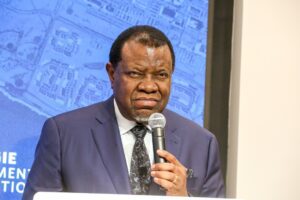
President Hage Geingob will not be travelling to the World Economic Forum (WEF) in Davos, Switzerland, this time around, as world leaders and chief executive officers flock to discuss the fate of the global economy amid the Russo-Ukrainian crisis in a post-pandemic era.
Geingob was at the summit last year where he sold the country’s renewable energy vision under the flagship Green Hydrogen mega-project, slated to kick off this year.
He also took the opportunity to flaunt a catalogue of 33 projects in the hopes of enticing the world to invest in Namibia.
The WEF is considered to be a global super-bowl of economic minds where investors flock to meet and dine with world leaders in the hunt for fertile investment ground.
When The Villager called on Tuesday afternoon, State House could not provide a reason as to why the president has decided not to participate this year.
“No, he isn’t [going]. I don’t know why he is not going. If he has a reason, I do not know that reason,” said Dr. Dennis Shikwambi, a State House functionary.
But the president seems to have set his eyes on the ‘Invest in Africa Energy Reception’ in London where presidential economic advisor and Green Hydrogen commissioner, James Mnyupe will be linking up with European investors to draw their interest towards Namibian green hydrogen opportunities.
The forum kickstarted this week Monday with the prospect of a global recession casting a long shadow over the event.
Two-thirds of private and public sector chief economists surveyed by the WEF expect a global recession this year, with some 18% considering it “extremely likely” – more than twice as many as in the previous survey conducted in September 2022, according to Reuters.
In the meantime, Geingob’s decision not to attend comes in the wake of him having suffered negative media spotlight recently concerning his international travels, prompting his office to issue a curt response.
In December of last year, The Namibian daily reported that the president could have pocketed about N$3 million in subsistence and travel (S&T) allowances from the 19 foreign trips he undertook last year, of which he spent 74 days out of the country.
The daily further reported that payout is the highest he has made from travels since that it began tracking his travelling when he became president seven years ago.
Incensed by the report, the State House clapped back, calling the travel allowances false and a mere concoction.
In a statement, the presidency said, “Allowances for the Head of State in the conduct of official missions are matters of policy, and President Geingob did not alter existing policies in that regard.”
Adding: “Presidents take Rate 2, which is the most cost-effective option and only caters for their meals and other incidental expenses because the state bears responsibility for their accommodation on official missions.”
WEF managing director Saadia Zahidi is quoted as saying:”The current high inflation, low growth, high debt and high fragmentation environment reduces incentives for the investments needed to get back to growth and raise living standards for the world’s most vulnerable.”
The return to Davos has been met with high expectations from a world trying to rediscover new growth paths post the pandemic era, while dealing with the European war in Ukraine.
Namibia has equally felt the shocks of the fighting as global food prices went up, and fuel inflation spiralled out of control before simmering down towards the end of 2022.
Geingob has also dubbed the year 2023 as that of revival.
“As a nation, we now have a good reason to cease looking backwards, but rather to look ahead and pull forward into the direction of inclusive progress and prosperity,” he said in his New Year’s message.
Search in the website:
Related articles
Fuel Under-Recovery to be Subsidised with Half a Billion NAD
View moreFuel Under-Recovery to be Subsidised with Half a Billion NAD
Nam Economy Has Only Expanded by N$14.1bn in 10 Years
View moreNam Economy Has Only Expanded by N$14.1bn in 10 Years
Dangote Refinery Filling African Oil Supply Gap
View moreDangote Refinery Filling African Oil Supply Gap
Govt Faces N$36.9 Billion Repayment Obligation in 4 years
View moreGovt Faces N$36.9 Billion Repayment Obligation in 4 years
Public Investment in Agriculture Shows Decline
View morePublic Investment in Agriculture Shows Decline

Namibians Consumed 6.9 Million GB on TikTok Content…data usage generates close to N$1 billion in 3 months
View moreNamibians Consumed 6.9 Million GB on TikTok Content…data usage generates close to N$1 billion in 3 months
2026: The Year of Key Final Investment Decisions on Nam Oil
View more2026: The Year of Key Final Investment Decisions on Nam Oil
NHE Grows Housing Loan Book, but Sankwasa Wants More Houses
View moreNHE Grows Housing Loan Book, but Sankwasa Wants More Houses

Comments