By: Hertha Ekandjo
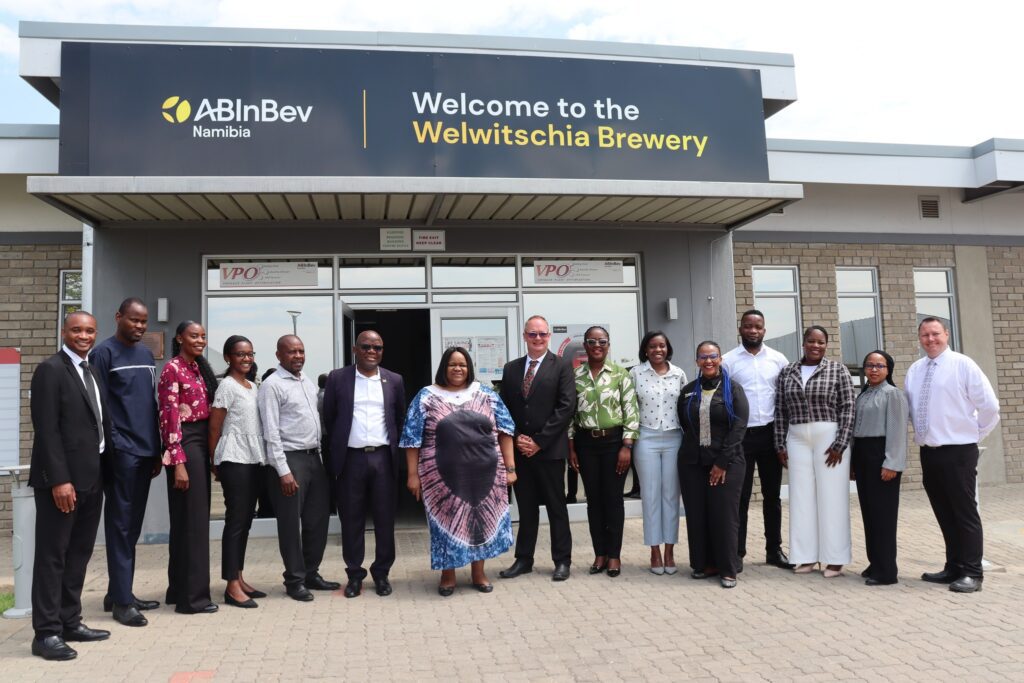
ABInBev Welwitschia Brewery, a local brewery, has announced a N$65.4 million investment in Solar Thermal Technology to be established in Okahandja.
The brewery’s objective is to reduce its carbon footprint by approximately 700 tons of carbon dioxide (CO2) emissions annually.
The solar thermal technology will harness solar heat to generate steam, which will be used in the brewing process.
This move aims to significantly reduce the brewery’s reliance on fossil fuels and promote a more environmentally friendly brewing process.
The announcement was made during a facility tour by Minister of Industrialization and Trade, Lucia Iipumbu, at ABInBev Beverages in Okahandja.
Zoleka Lisa, ABInBev’s Vice President for corporate affairs, explained that this N$65,4 million investment in thermal technology aligns with the brewery’s commitment to becoming more environmentally sustainable, lowering production energy costs, and contributing to Namibia’s sustainability efforts.
ABInBev is a major player in the Namibian brewing industry, producing more than ten beverages, including Carling Black Label, Castle Lite, Castle Lager, and Eagle Lager, with four brewed locally.
In addition to its solar thermal energy initiative, the brewery is also working on a water stewardship project aimed at improving water availability for the Okahandja community.
Lisa stated, “We are working with the Municipality of Okahandja to develop a water stewardship project to improve access to water for the community,” with specific focus on the Five Rand and Vergenoeg communities facing water supply challenges.
Namibia has been globally ranked as one of the 30 driest countries, making water management and sustainability crucial.
ABInBev’s goal is to enhance water availability and quality across its operations, value chain, and the communities it serves.
The beer industry is a significant contributor to Namibia’s economy, annually contributing around N$2,94 billion to the GDP, generating 9,000 jobs across the value chain, and contributing N$1.26 billion in taxes in the previous year.
ABInBev operates in Namibia with one brewery, three depots, and a corporate head office, employing 146 staff and collaborating with over 200 local suppliers in various areas, including water treatment, waste management, and third-party transporters.
During the event, Minister Iipumbu encouraged ABInBev to diversify its product offerings by considering the production of soft drinks and children’s beverages, in addition to its alcoholic beverages.
“I do not enjoy the fact that it is just maybe 30% of it that is bottled in the country, while we have so many fountains. We have Waterberg there, and nobody goes there and takes that water which is mineral and pure, and bottles it for local consumption,” said Iipumbu.
She noted that there are untapped opportunities in these areas, especially given the availability of natural mineral water sources in Namibia.
“Those are some of the areas that I want you to look at, even soft drinks, there are those that are religious and would not want to have a beer,” she explained.
Namibia currently exports its beer to several countries, including Botswana, Zambia, Democratic Republic of the Congo, Mozambique, Tanzania, Zimbabwe, and Kenya.
Despite the diversified market of exports and local consumption, the country has experienced fluctuations in beer production in 2023, with the highest volume produced in April, followed by a decline.
The highest volume of alcoholic beverages produced for this year so far was 158,544 hectolitres in April according to the Namibia Statistics Agency (NSA).
However, compared to 2022, this is quite low as in the same month last year 194,962 hectolitres were produced.
The only other month that recorded a high volume is March with 157,422 hectolitres of alcoholic beverages produced.
Beyond those months, production has dwindled to below 145,000 hectolitres.
The alcoholic beverage production decline got worse at the end of July 2023, reaching 106,261 hectolitres, according to the data.
This is a recorded monthly decline of 22.6% in July 2023 compared to an increase of 1.6% recorded a month earlier, Despite Namibia’s alcoholic beverages production, the country still imports a significant volume of alcohol, mostly from South Africa.
Notably, Namibia continues to import a significant volume of alcohol, primarily from South Africa, but has also sourced alcoholic beverages from countries such as Taiwan, Germany, the United States of America, Austria, the United Kingdom, and Portugal in the past seven months.

Comments